Ancient Anchors Lost
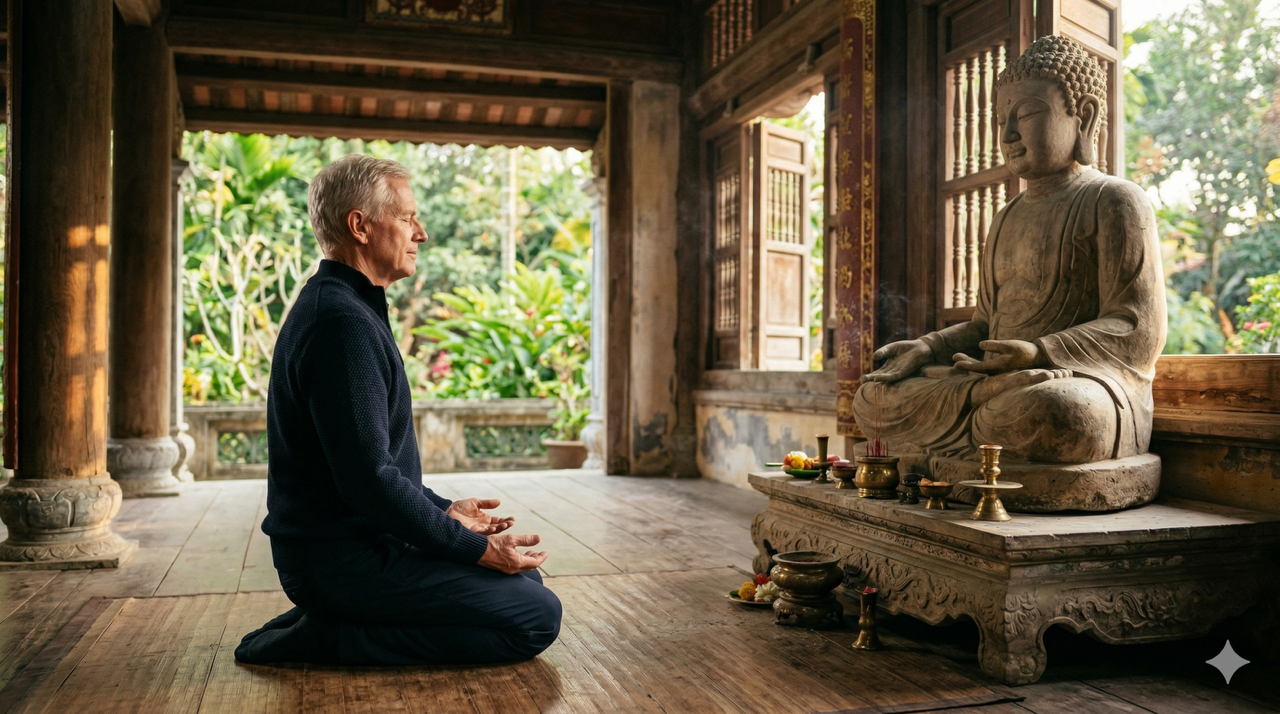
I knelt before a statue of Buddha in a temple in Vietnam, and something happened that I did not expect. I felt peace. Not the idea of peace. Not a theological understanding of peace. Something my body recognized before my mind could name it. The statue was serene. Eyes half-closed. Hands resting open. The entire posture radiated stillness, and without any instruction or doctrine, my nervous system responded. I softened. I settled. I was, for a moment, simply present.
And then a question rose in me that has not left since: Where is this experience in my own tradition? Where, in the faith I have followed my whole life, is the physical anchor that invites the body into the presence of the divine?
That question opened a door I was not expecting. What I found behind it was a pattern—one that stretches across centuries and continents and traditions. A pattern in which something original, something felt and embodied and alive, is slowly replaced by something managed. Edited. Controlled. The original encounter with the sacred gets buried beneath layers of philosophy, politics, and institutional necessity, until the thing people practice bears only a faint resemblance to the thing that first set hearts on fire.
I want to trace that pattern here, as carefully and honestly as I can. Not to condemn any tradition. But to ask a question I think we owe ourselves: What was lost, and is it possible to recover it?
We tend to imagine the ancient Israelite temple as a place of stark, imageless monotheism. A single God, invisible and untouchable, worshipped through words and sacrifice alone. But what I have found in studying the historical and archaeological record tells a different story—and it is one that genuinely surprised me.
Asherah, often understood as the consort of El, represented the feminine dimension of the divine. Archaeological sites across ancient Israel and Judah have yielded thousands of small pillar figurines associated with her—found not only at public shrines and high places, but in homes. These were intimate, domestic images. People kept them close. The inscriptions at Kuntillet Ajrud, dated to around 800 BCE, contain blessings that invoke “Yahweh and his Asherah”—paired together as naturally as breath and body. This does not appear to have been fringe practice. For many, it seems to have been simply how the divine was understood: both masculine and feminine, both transcendent and near, both invisible and visually anchored.
I find that worth sitting with for a moment. What might it have felt like to hold that kind of wholeness in your understanding of God?
The biblical text itself preserves some remarkable details. Second Kings describes the reforms of King Josiah around 621 BCE, in which he removed from the Jerusalem temple—Solomon’s temple—the Asherah pole, vessels made for Baal, and quarters where women wove hangings for Asherah. In my experience, when people hear this for the first time, it stops them. These were not rural, uneducated practices happening at the margins. These images and rituals appear to have existed inside the most sacred space in the tradition. The people who maintained them were not apostates. They were worshippers. They simply seem to have understood the divine as something that could be approached through the body and the senses, not only through the mind.
And when I look at the design of the tabernacle itself, this seems to be woven into the very instructions. Every detail of its construction was sensory: specific colors of fabric, specific arrangements of space, specific scents of incense, and at its center, the Shekinah glory—a visible, luminous presence. What if the message was never “Think about Me” but something closer to “Build a place where you can experience My presence with your whole being”?
What happened next was not a single event. In my reading of the scholarship, it appears to have been a slow, deliberate, centuries-long editorial and theological project. The Deuteronomistic reformers—the voices behind much of what we read in Deuteronomy, Joshua, Judges, Samuel, and Kings—sought to consolidate worship around a single, imageless God in a single, centralized temple. The high places were destroyed. The Asherah poles were cut down and burned. The feminine face of God was removed from the tradition. And El, the older, broader, more peaceful deity, was gradually absorbed into Yahweh until the two became indistinguishable in the text.
The cost, as best I can see it, was the body. The senses. The visible, tangible, felt experience of the divine. What had been a rich, multidimensional practice of worship—one that included feminine presence, physical images, and sensory engagement—was reduced to word, law, and abstraction.
Here is something I keep returning to: you do not write prohibition after prohibition against something that is not happening. Every command to destroy the images is, in a way, evidence that the images were beloved. Every condemnation of the high places confirms that people went there to pray. What does that tell us about the human heart and its longing for a felt connection with the divine?
This is where the history becomes even more interesting to me personally, because the pattern did not stop with the ancient Israelites. It appears again and again, in tradition after tradition, century after century. The original encounter is alive. Then the institutions arrive. And slowly, the living thing is replaced by the system built to preserve it.
He said remarkably little about building institutions. He wrote nothing down. What he left behind was not a system but an experience—the felt encounter with a particular quality of love, compassion, and presence that the people around him could not explain but also could not deny.
And then the editing began.
Within three centuries of his death, the Roman Empire adopted Christianity as a political instrument. The Council of Nicaea in 325 CE was convened not by a theologian but by Emperor Constantine, who needed religious unity to hold a fracturing empire together. What had been a diverse, often contradictory collection of communities, practices, and texts was systematized into an approved creed. Gospels that did not align with the emerging orthodoxy—the Gospel of Thomas, the Gospel of Mary, texts found at Nag Hammadi in 1945—were excluded, and in some cases actively destroyed. The embodied, relational, often disruptive experience of the early communities was gradually replaced by hierarchy, doctrine, and institutional authority.
The story of Buddhism follows a strikingly similar arc. Siddhartha Gautama, as the earliest Pali texts describe him, was not teaching a philosophy. He was pointing to a direct experience. Sit down. Pay attention to your breath. Watch what arises in the mind without grasping or rejecting it. The practice was radically immediate—no intermediary, no priesthood, no metaphysical system required. Just a human being, sitting still, learning to see clearly.
Within a few centuries of his death, Buddhism had fractured into competing schools with elaborate philosophical systems. The Abhidharma tradition produced volumes of metaphysical categorization—cataloguing states of consciousness, mapping layers of reality, constructing frameworks so complex that a person could spend a lifetime studying them and never once sit down to meditate. Later developments brought hierarchies, rituals, political alliances with monarchies, and in some cases, monastic institutions that looked remarkably like the very power structures the Buddha had walked away from.
None of this was necessarily done with bad intent. The people who built these systems believed they were preserving something precious. And in many ways they did. But the relationship between the original experience and the institution built around it is, I think, one of the most important questions any tradition can ask itself. Because the system built to protect the fire can, over enough time, become the thing that walls you off from it.
In Islam, the pattern is perhaps the most compressed and therefore the most visible. The Quran describes Muhammad’s initial encounter with the divine as an overwhelming, embodied experience. In the cave on Mount Hira, the angel Jibril seized him, pressed him until he could barely breathe, and commanded him to recite. Muhammad reportedly trembled, sweated, and returned home wrapped in a cloak, shaken to his core. His wife Khadijah held him and reassured him. The experience was physical before it was theological.
Within a generation of Muhammad’s death in 632 CE, the community had already split over political succession. The Sunni-Shia divide, which shapes so much of the Islamic world today, was not originally a theological disagreement. It was a political one: who had the legitimate right to lead? From there, the legal schools developed—Hanafi, Maliki, Shafi’i, Hanbali—each constructing increasingly detailed frameworks for how to live a faithful life, down to which hand to use when eating and how many steps to take entering a mosque. The Sufi mystics, who sought to preserve the direct, felt encounter with the divine that Muhammad himself had experienced, were periodically persecuted by the very institutions that claimed his legacy.
Again, I want to be careful. Every one of these developments has its own integrity and its own logic. But the pattern is, I think, unmistakable. Something alive and embodied and immediate is experienced by a human being. A community forms around that experience. The community becomes an institution. The institution builds systems to preserve the experience. And over time, the systems become the thing—and the experience recedes behind them.
The Dead Sea Scrolls offer a quiet footnote to this larger story that I find particularly striking. In the Qumran manuscript 4QDeut, the text of Deuteronomy 32:8–9 reads differently from the standard Masoretic Bible. Where the later text says God divided the nations according to the “sons of Israel,” the older scroll reads “sons of God”—b’nei elohim. The Septuagint, the Greek translation made centuries before the Masoretic text was standardized, appears to agree. The earlier reading survived in the desert while the edited version became the standard.
So what do we do with this?
But I do think we owe ourselves the honest question: How much of what I practice is the living thing, and how much is the system built around the living thing? When I pray, or meditate, or attend a service, am I touching the experience that set the tradition on fire in the beginning? Or am I performing the rituals that were built to manage and contain that fire?
The physical images in the ancient Israelite temple—the statues of El in his peaceful, seated repose, the Asherah figurines held close in homes, the luminous presence between the cherubim—were, in my understanding, never about idolatry. They were about landing. They gave the body a place to rest in the presence of something larger. They did not replace God. They helped people arrive.
And when they were removed, what seems to have replaced them was theology. Doctrine. Law. Performance. A religion of action, obligation, and correctness—rather than a spirituality of presence, surrender, and rest. The same pattern that would repeat itself in tradition after tradition, century after century, as the felt encounter with the sacred was gradually converted into a system for thinking about the sacred.
I believe we have been living in the echo of that loss ever since.
The question for anyone who follows any of these traditions, as I see it, is not whether the original experience is still available. I believe it is. The question is whether we have given ourselves permission to seek it beneath the layers that have been built on top of it. To quiet the body and the mind long enough to sense the goodness, the mercy, the deep kindness that these teachers embodied. Not to think about it. Not to recite it. To feel it—the way the ancient worshipper may have felt it standing before the Shekinah, or holding a small figure of Asherah close in the stillness of home, or being touched and healed the way those who encountered Christ were touched and healed, or sitting in silence the way the Buddha sat, or trembling the way Muhammad trembled in the cave.
What if the invitation has never been to do more, believe harder, or get the theology exactly right? What if the invitation has always been to come home? To settle? To let the body remember what the mind has been arguing about for centuries?
In my experience, the anchors were real. The images were real. The felt, embodied, sensory experience of the divine was real. It was not a primitive stage that needed to be outgrown. It was a wisdom that was taken—again and again, across traditions, across centuries—and that I believe we are free to recover. Not by building statues or dismantling churches. But by understanding what the original experience made possible: a place where the body could rest, the mind could quiet, and the soul could remember that it was never separate from its Source.
That remembering is available to anyone. It does not require a temple, a tradition, or a system. It requires only the willingness to stop, to soften, and to let what has always been true prevail.
I invite you to ponder what it might mean—in your own life, in your own body, in your own quiet moments—to simply let the divine prevail. And that, for me, is the quiet return.

Speaker/Author/Coach/Radio & TV Personality/Podcaster
In a timeless parable, a man sells his farm in pursuit of diamonds, only to learn that the new owner uncovers record numbers of diamonds in the same land, waiting to be discovered. Dr. Doug Gulbrandsen, much like the new owner, is dedicated to helping individuals uncover, appreciate, and refine their inherent personal treasures.
As the esteemed host of the Inspire Vision Podcast, Dr. Doug has spent the past 15 years prior to his podcast focusing on guiding and mentoring individuals and business owners towards lives filled with happiness, fulfillment, and prosperity. His impact has been profound, as evidenced by the lasting transformation experienced by his clients.
Larry Peterson, a certified financial planner and managing member of Amicus Settlement Planners, attests to the enduring benefits of Dr. Doug's guidance, even a decade after their collaboration. "I was prepared to be proactive for my own growth," Larry reflects. "Dr. Doug Gulbrandsen provided me with powerful tools to achieve that growth, including cultivating an abundance mindset for both me and my wife, and leveraging our behavioral profiles to work and live more effectively within our inherent strengths."
Dr. Doug's influence extends far beyond theory, as his clients have witnessed remarkable shifts in every facet of their lives. One client, inspired by Dr. Doug's training, doubled his time spent with family while simultaneously doubling his business revenue. Another client, reeling from a significant business loss, experienced an immediate elevati… Read More
The Spiral Within: What Snail Shells Teach Us About Humanity